Azeroth Survivors classes: all nine, side by side
Updated 2026-11-02
Version game build 3dee002, upstream synced 2026-09-24
Nine Azeroth Survivors classes ship in the game's own data file, and each one starts with a single ability and owns a pool of 6 to 11 more. This page puts all nine side by side, adds starting numbers, 8 races and 2 factions, and links a build page for every class. For ratings, see the tier list.
How many Azeroth Survivors classes are there?
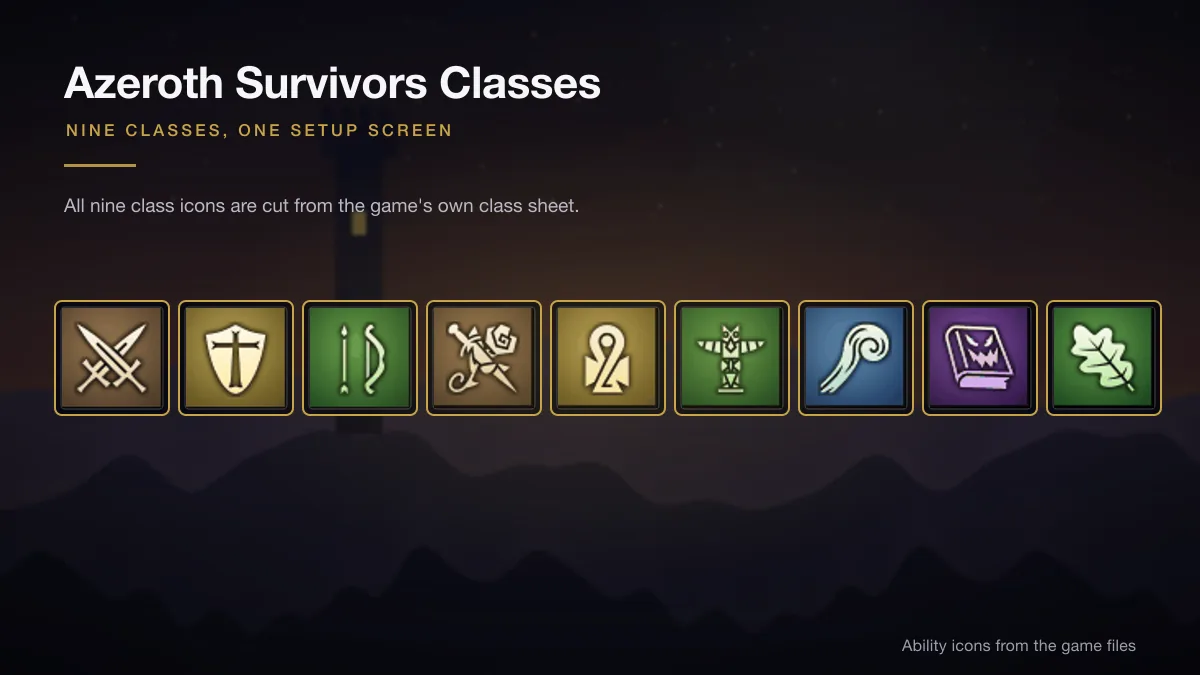
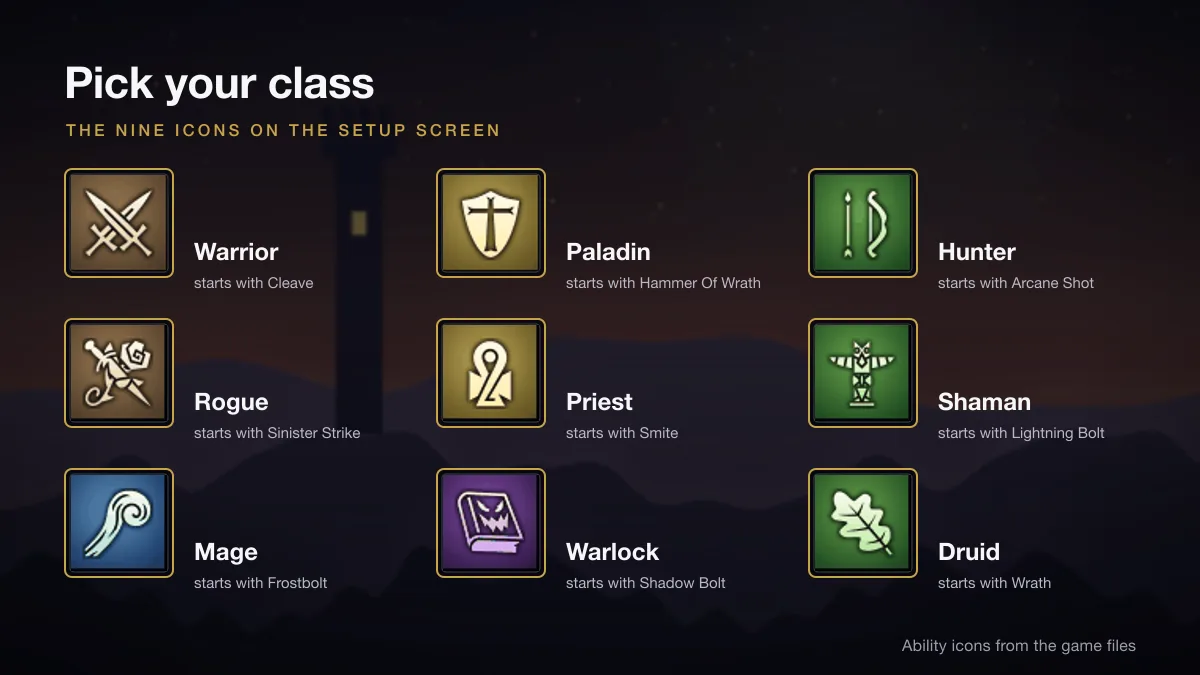
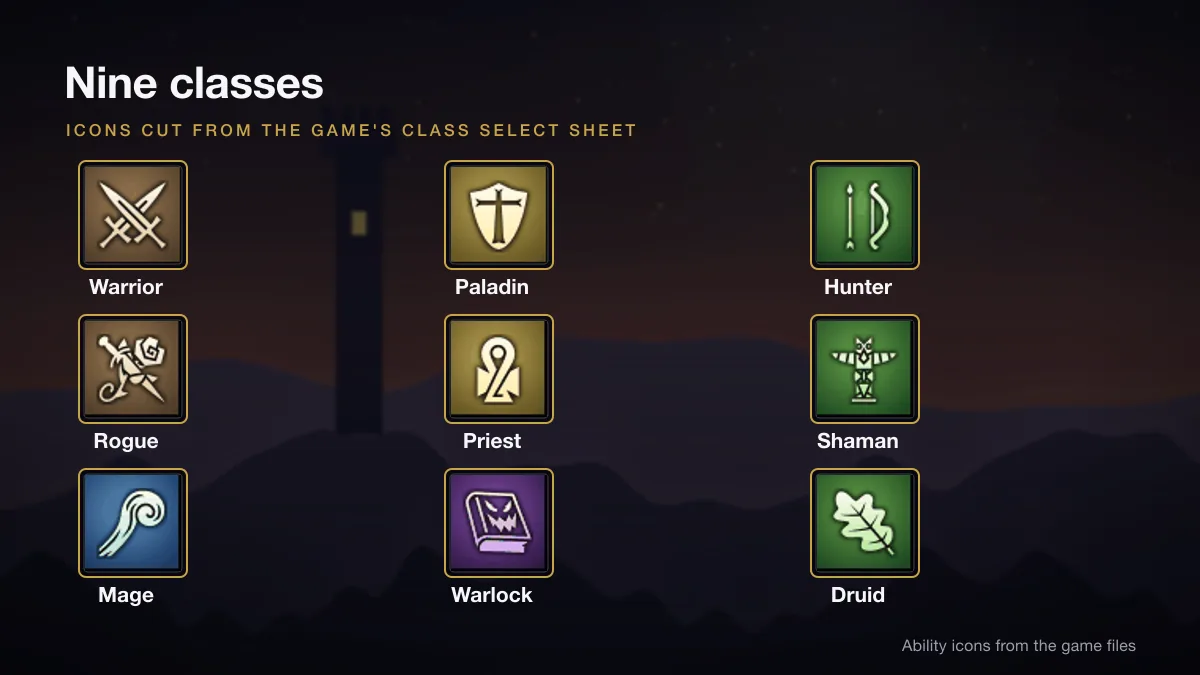
There are nine Azeroth Survivors classes: Warrior, Paladin, Hunter, Rogue, Priest, Shaman, Mage, Warlock and Druid. Each one starts with its own ability and draws level-up cards from a private pool, and pool sizes differ from class to class.
| Class | Role in a run | Starting ability | Power | Cards in pool |
|---|---|---|---|---|
| Warrior | Frontline plate fighter who crushes the swarm by force | Cleave (melee) | rage | 9 |
| Paladin | Hammer-and-shield justiciar who lays down consecration | Hammer Of Wrath (bolt) | mana | 8 |
| Hunter | Crossbow ambusher with venom traps and arrow volleys | Arcane Shot (bolt) | mana | 7 |
| Rogue | Dual-blade assassin who threads the gaps | Sinister Strike (melee) | energy | 6 |
| Priest | Holy novas and a void scream out of the sanctum | Smite (strike) | mana | 7 |
| Shaman | Storm sage who seals passageways with totems | Lightning Bolt (bolt) | mana | 8 |
| Mage | Frost novas and storms of flame at long range | Frostbolt (bolt) | mana | 11 |
| Warlock | Shadow curses and hellfire called down from above | Shadow Bolt (bolt) | mana | 9 |
| Druid | Roots, insect swarms and burning starlight | Wrath (bolt) | mana | 8 |
Power type splits the same way the class list does: seven of the nine run on mana, the Warrior on rage and the Rogue on energy. It is the only per-class stat the data file carries, and this page does not put health, armour or damage columns next to it, because the file has none.
A build page for every class
- Warrior build: Cleave, 9 cards
- Paladin build: Hammer Of Wrath, 8 cards
- Hunter build: Arcane Shot, 7 cards
- Rogue build: Sinister Strike
- Priest build: Smite, 7 cards
- Shaman build: Lightning Bolt, 8 cards
- Mage build: Frostbolt, 11 cards
- Warlock build: Shadow Bolt, 9 cards
- Druid build: Wrath, 8 cards
The builds index collects the same nine pages, the how to play guide covers the controls and the level-up loop, and the troubleshooting page is the one to open if a run will not start at all. Playing on a phone or a tablet? Read the mobile page before you pick a class.
What does each Azeroth Survivors class start with?
Every class starts with one ability the game hands over before the first level-up, and that card is all you own in the opening wave. Six of the nine start on a bolt, two on a melee swing and one on a strike, and the numbers below come straight from the game's ability table.
| Class | Starting ability | Type | Damage | Cooldown | Range | Targets |
|---|---|---|---|---|---|---|
| Warrior | Cleave | Melee | 14 | 1.1 s | 5.5 | 3 |
| Paladin | Hammer Of Wrath | Bolt | 16 | 1.5 s | 24 | 1 |
| Hunter | Arcane Shot | Bolt | 13 | 1 s | 28 | 1 |
| Rogue | Sinister Strike | Melee | 15 | 0.85 s | 5.5 | 1 |
| Priest | Smite | Strike | 14 | 1.2 s | 20 | 1 |
| Shaman | Lightning Bolt | Bolt | 15 | 1.3 s | 24 | 1 |
| Mage | Frostbolt | Bolt | 12 | 1.3 s | 24 | 1 |
| Warlock | Shadow Bolt | Bolt | 15 | 1.4 s | 24 | 1 |
| Druid | Wrath | Bolt | 13 | 1.2 s | 24 | 1 |
Read the last three columns before the damage column. Melee starters reach 5.5 units and only hit what walks into you, while the ranged starters reach 20 to 28 units and fire by themselves, so a Warrior or Rogue game is movement, and a Mage or Hunter game is positioning. Cleave is also the only starter that hits three targets at once, which is why it carries the highest cooldown of the two melee cards.
Damage per hit sits in a narrow band, 12 for Frostbolt up to 16 for Hammer Of Wrath, so no starter decides a run on its own. The Mage's bolt is the weakest of the nine and it is also the only starter that slows: Frostbolt applies a 50% slow for 2.5 seconds, which is the whole difference between walking away from a pack and being caught by it.
How many abilities does each Azeroth Survivors class pool have?
Pool sizes differ between classes, and pool size changes a run more than any other class fact: a small pool is finished early and pushes later levels into upgrades, while a large one keeps handing out new cards deep into a run.
The matrix below counts every card in a pool by the type tag the data file gives it. A class that repeats one tag hands out a very readable level-up screen; a class spread over six tags keeps asking you to learn a new name.
| Class | Cards | Melee | Bolt | Nova | Strike | Ground | Dot | Other |
|---|---|---|---|---|---|---|---|---|
| Warrior | 9 | 3 | 0 | 3 | 1 | 0 | 0 | Aura 1, Thorns 1 |
| Paladin | 8 | 0 | 1 | 1 | 4 | 1 | 0 | Immune 1 |
| Hunter | 7 | 0 | 5 | 0 | 0 | 2 | 0 | none |
| Rogue | 6 | 4 | 0 | 1 | 0 | 0 | 1 | none |
| Priest | 7 | 0 | 0 | 2 | 3 | 0 | 1 | Shield 1 |
| Shaman | 8 | 0 | 1 | 0 | 3 | 0 | 0 | Chain 1, Totem 2, Orbit 1 |
| Mage | 11 | 0 | 4 | 3 | 1 | 2 | 0 | Cone 1 |
| Warlock | 9 | 0 | 2 | 0 | 3 | 1 | 2 | Aura 1 |
| Druid | 8 | 0 | 1 | 0 | 2 | 1 | 2 | Thorns 1, Heal 1 |
One intermediate tag is worth knowing about before the full list: Consecration is typed GroundSelf, an area that stays on you rather than on the ground, so it is counted under Ground here. The nine pools use 16 tags in total, from Melee and Bolt to Totem, Cone and Heal.
Every card in every pool
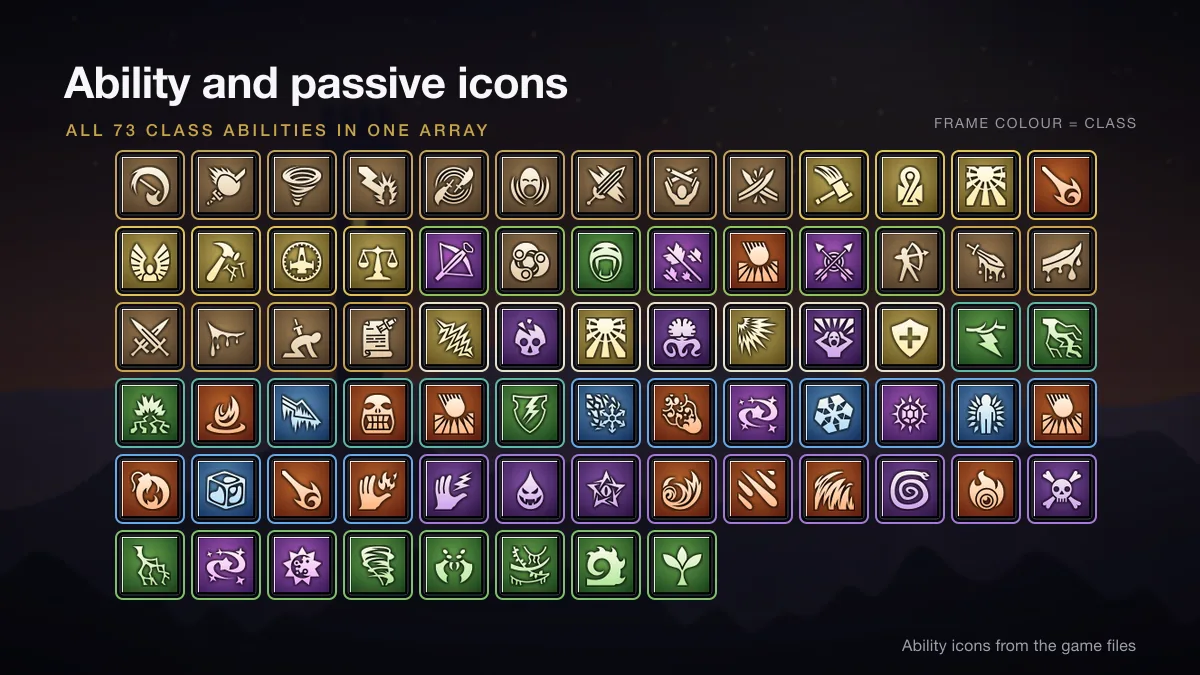
The class abilities in the order the data file lists them. The starting ability repeats inside its own pool, because it is both the card you begin with and the one you keep levelling.
| Class | Starting ability | Pool, in data order |
|---|---|---|
| Warrior | Cleave (Melee) | Cleave (Melee), Heroic Strike (Melee), Whirlwind (Nova), Thunder Clap (Nova), Sweeping Strikes (Aura), Demoralizing Shout (Nova), Execute (Strike), Mortal Strike (Melee), Retaliation (Thorns) |
| Paladin | Hammer Of Wrath (Bolt) | Hammer Of Wrath (Bolt), Consecration (GroundSelf), Holy Shock (Strike), Exorcism (Strike), Holy Wrath (Nova), Hammer Of Justice (Strike), Divine Shield (Immune), Judgement (Strike) |
| Hunter | Arcane Shot (Bolt) | Arcane Shot (Bolt), Multi Shot (Bolt), Serpent Sting (Bolt), Volley (Ground), Explosive Trap (Ground), Concussive Shot (Bolt), Aimed Shot (Bolt) |
| Rogue | Sinister Strike (Melee) | Sinister Strike (Melee), Eviscerate (Melee), Blade Flurry (Nova), Rupture (Dot), Gouge (Melee), Kidney Shot (Melee) |
| Priest | Smite (Strike) | Smite (Strike), Shadow Word Pain (Dot), Holy Fire (Strike), Mind Blast (Strike), Holy Nova (Nova), Psychic Scream (Nova), Power Word Shield (Shield) |
| Shaman | Lightning Bolt (Bolt) | Lightning Bolt (Bolt), Chain Lightning (Chain), Earth Shock (Strike), Flame Shock (Strike), Frost Shock (Strike), Searing Totem (Totem), Magma Totem (Totem), Lightning Shield (Orbit) |
| Mage | Frostbolt (Bolt) | Frostbolt (Bolt), Fireball (Bolt), Arcane Missiles (Bolt), Frost Nova (Nova), Arcane Explosion (Nova), Blizzard (Ground), Flamestrike (Ground), Fire Blast (Strike), Cone Of Cold (Cone), Blast Wave (Nova), Pyroblast (Bolt) |
| Warlock | Shadow Bolt (Bolt) | Shadow Bolt (Bolt), Corruption (Dot), Curse Of Agony (Dot), Immolate (Strike), Rain Of Fire (Ground), Hellfire (Aura), Death Coil (Bolt), Searing Pain (Strike), Shadowburn (Strike) |
| Druid | Wrath (Bolt) | Wrath (Bolt), Moonfire (Strike), Starfire (Strike), Hurricane (Ground), Insect Swarm (Dot), Entangling Roots (Dot), Thorns (Thorns), Rejuvenation (Heal) |
A tag says how an ability picks its targets and nothing else. There is no damage, cooldown or radius column attached to a tag, so a big pool is not a stronger pool: the Mage's 11 cards and the Rogue's 6 share the same damage band, and the Rogue gets to level 8 on the cards it owns sooner.
How do you pick an Azeroth Survivors class?
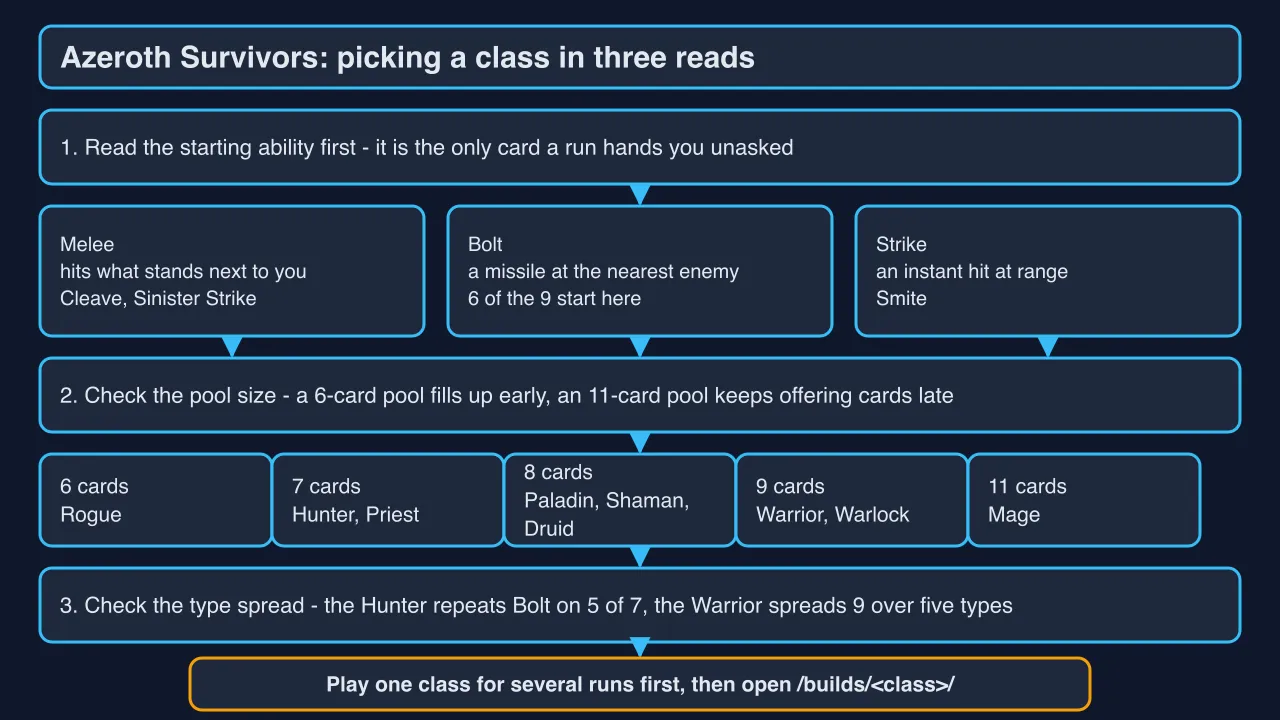
Pick on the starting ability first, then on pool size, and only then on how varied the card list looks. Those three facts are in the data file and they decide what the first five minutes feel like; anything beyond them is a judgment about play, and the file ships no class stats to back one up.
- Read the starting-ability column first, because that one card is what every run of the class begins with and you never get to choose it.
- Compare pool sizes next, since a 6-card pool fills up early and turns later levels into upgrades, while an 11-card pool keeps offering new names.
- Check the type spread after that, because a pool repeating one tag gives a consistent level-up screen and a pool over six tags asks you to relearn every card.
- Skim the full pool list before you commit, because the ability you cannot picture is the one you will skip at the level-up screen.
- Leave the race pick for last, because race and class are independent columns and no race fixes a class you do not enjoy.
- Play one class for several runs before switching, since a pool only reads properly once the card names stop being noise.
- Level what you already hold before reaching for a new slot, because six abilities at level 8 beat six abilities at level 2.
Common mistakes when you pick a class
- Treating the class grid as a difficulty list: nothing in the data says which class is harder, so a pick made on somebody's sense of difficulty is a guess.
- Taking the 11-ability Mage because more cards sound stronger: a bigger pool also means more cards you skip on the way to the good ones.
- Waiting for the perfect starting ability: every class begins with one card, and the pool opens as you level.
- Reaching for a seventh ability: six is the cap, so the next level has to go into the abilities you already hold.
- Collecting new cards while the old ones sit at level 1: each ability goes to level 8, and levels are what make a card hit.
- Expecting the race pick to change the pool: race and class are separate columns and there is no racial ability in the file.
Do races or factions change your Azeroth Survivors class?
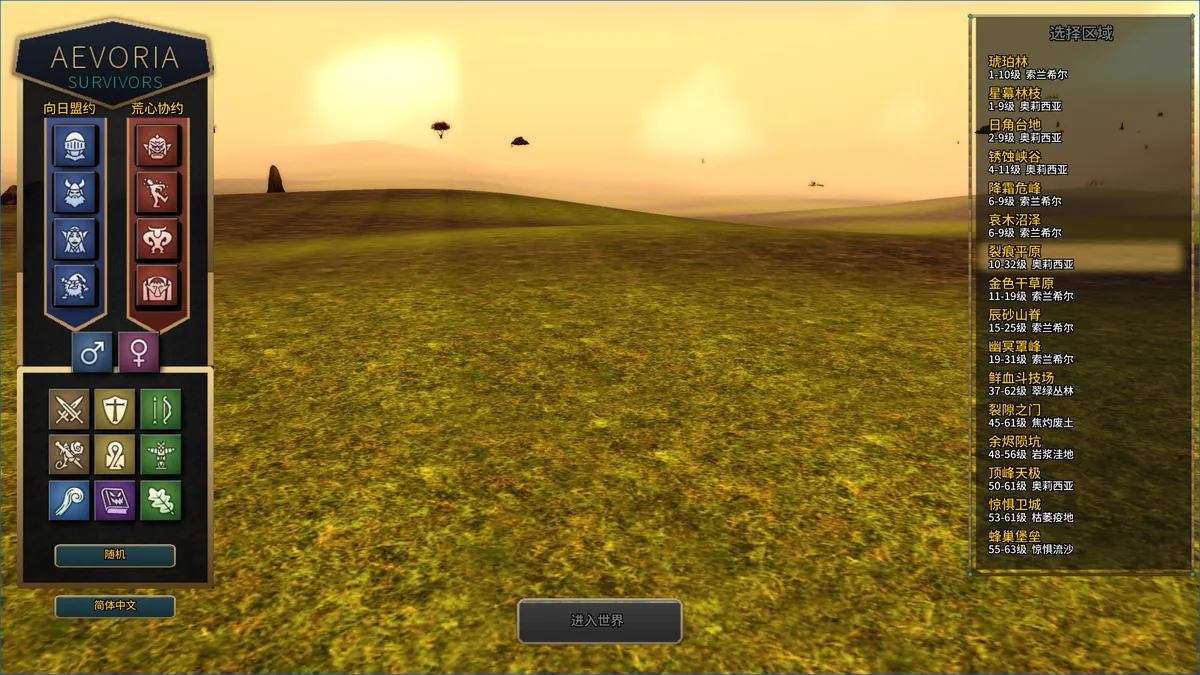
No. Race and class are two independent columns on the setup screen: the eight races carry no ability, no card pool and no stat of their own, and the data file has no line tying an ability to a race. Faction is lore text as well, four races per side and no bonus attached.
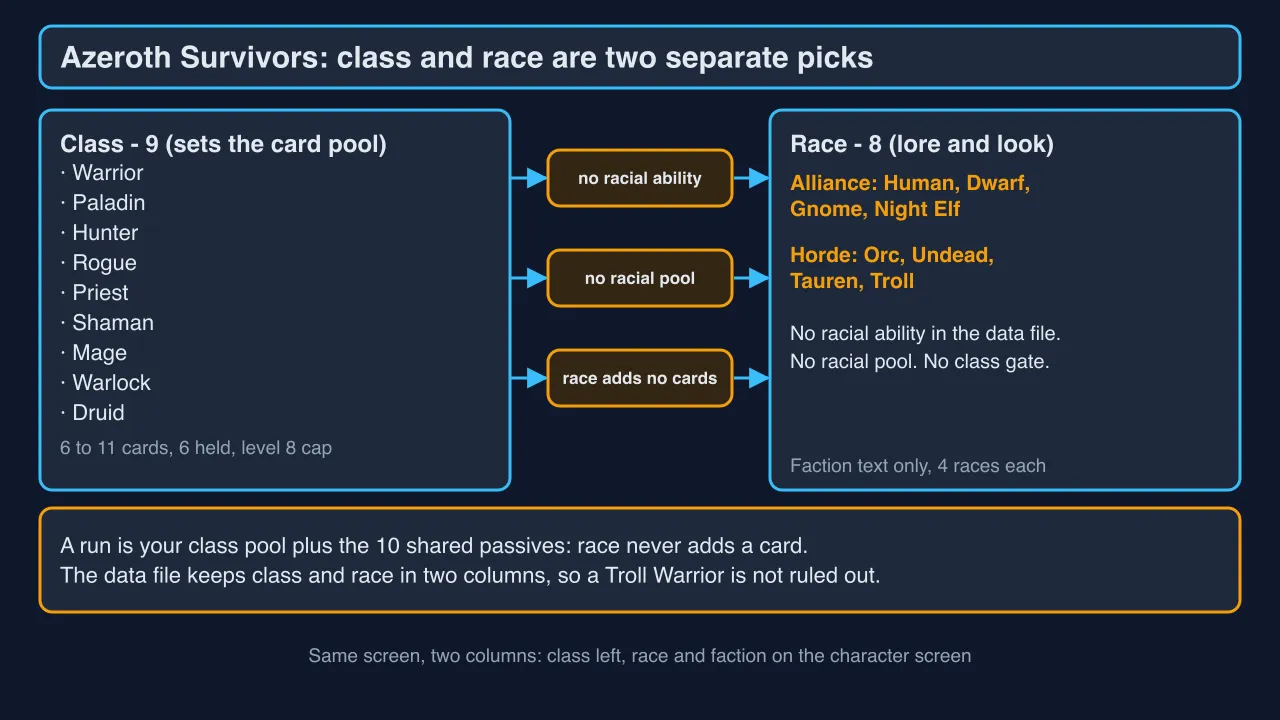
The two picks do live in two different client tables, which is where the independence comes from. Class names and ids come from one per-class table and race names and ids from a separate per-race table, and neither table carries a link to the other. The game stores a class id and a race id on the character and reads them separately, so nothing stops a Troll Warrior or a Human Druid.
What the files do leave open is which race models a given class can wear. The repository keeps only display ids and lets the client's creature display data do the mapping, so no combinations are claimed on this page. In practice the race pick is a look and a piece of lore, and the class pick is the run.
Which 8 races and 2 factions are there in Azeroth Survivors?
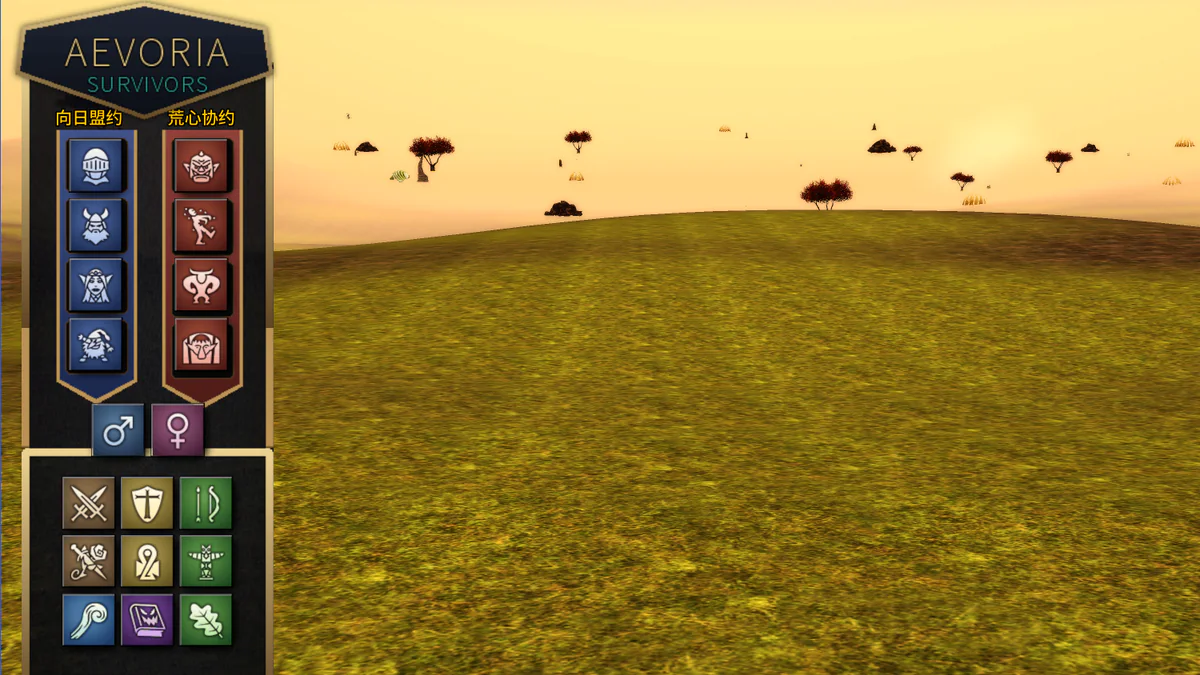
There are eight playable races, four in each faction: Human, Dwarf, Gnome and Night Elf on the Alliance side, Orc, Undead, Tauren and Troll on the Horde side. Every race is pure flavour for a run, and none of them changes the card pool you draw from.
| Race | Faction | Who they are |
|---|---|---|
| Human | Alliance | Adaptable daylight descendants, built for formations and light-forged runes |
| Dwarf | Alliance | Stone-kin from crystal caverns in a hard silica shell, forged for hammer work |
| Gnome | Alliance | Small, curious glimmer-children mixing plant sap with clockwork generators |
| Night Elf | Alliance | Tall star-vault remnant with night-lit pupils, guarding eclipse sorcery |
| Orc | Horde | Green-skinned fighters with bodies like iron, under a primal law of honour |
| Undead | Horde | Risen corpses freed from a spore hive, bodies running with fungal fluid |
| Tauren | Horde | Great-horned bull-headed people, calm as mountains, charging like a rockslide |
| Troll | Horde | Lean tusked ambushers brewing swamp voodoo and insect venom |
The two factions are the Alliance, a daylight order built on discipline and precision crystal machinery, and the Horde, a wildblood pact rooted in bloodline power and the pulse of nature. Both are described in the game's lore file as peoples rather than as rules, which matches the data: four races per side, no stat difference between them.
What limits do all nine Azeroth Survivors classes share?
Every class obeys the same run limits: a fixed number of ability slots, a level cap on each ability, and passives drawn from one shared pool. Bosses arrive at intervals through the run, whoever you picked.
| Limit | Value | What it means in a run |
|---|---|---|
| Abilities held | 6 | The seventh card cannot be taken, so later levels upgrade what you own |
| Ability level cap | 8 | Two abilities at 8 beat six abilities at 1 |
| Passives held | 6 | From a pool shared by all nine classes, never from the class pool |
| Passive level cap | 5 | Each passive level is a flat percentage on one stat |
| Run length | Fixed | The run ends when the timer runs out |
| Boss timer | Recurring | Bosses drop at intervals through the run |
The passive list is the one part of the run no class owns. Ten cards, same ten for a Warrior and a Mage, each worth a percentage per level on one stat:
| Passive | Stat it raises | Per level |
|---|---|---|
| Blessing of Might | Attack power | 10% |
| Power Word: Fortitude | Max health | 20% |
| Aspect of the Pack | Move speed | 10% |
| Renew | Health regen | 50% |
| Arcane Intellect | Attack and cast speed | 8% |
| Amplify Magic | Area of effect | 10% |
| Detect Lesser Invisibility | Pickup radius | 40% |
| Blessing of Wisdom | Experience gain | 8% |
| Mark of the Wild | Armour | 1.0 per level |
| Blessing of Kings | Crit chance | 5% |
That cap is why the class grid and the passive list are worth reading together: a 6-card Rogue pool runs dry against a 6-slot holding limit, so from the moment the pool is spent the run is passive levels and ability levels. The Mage's 11 cards spend longer filling the same six slots, and the two heroes end the run on the same caps.
Azeroth Survivors classes FAQ
How many Azeroth Survivors classes are there?
There are nine Azeroth Survivors classes: Warrior, Paladin, Hunter, Rogue, Priest, Shaman, Mage, Warlock and Druid. Each has one starting ability and its own pool, and pool sizes differ from class to class. No pool is shared between two classes.
How does each Azeroth Survivors class play?
The data file gives the nine Azeroth Survivors classes a starting card, a pool and a power type, with no health, damage or difficulty column, so a class is read through its opener and its pool: the Warrior spreads 9 cards over five tags, the Hunter keeps 5 of its 7 on bolt, and the Mage has the widest list at 11.
Which class is easiest for a first run?
Start with a class whose pool repeats a few tags, because the level-up cards then look familiar quickly. The Rogue has 4 melee cards among only 6, the Hunter 5 bolts among 7, and the Warrior 3 melee and 3 nova cards among 9, so all three give a short, readable card list.
Do races change your class in Azeroth Survivors?
No. Race and class are two columns on the setup screen, and the data has no racial ability, no racial pool and no line tying an ability to a race. The eight races sit in two factions, four each, and faction is lore rather than bonuses. Which race models a class can wear is left to client display data.
Can I change class during a run?
The class you start with owns the card list for that run: nine separate pools, one starting ability each, and nothing that lets one class borrow another's cards. A run is built around the class picked at the start, and a different pool means a new run.
What does power type do for a class?
Power type is the one per-class stat in the file: seven classes run on mana, the Warrior on rage and the Rogue on energy. This game mode has no mana bar to manage, so the value labels the class rather than gating your casts; abilities fire on their own cooldowns either way.
How many abilities and passives can I hold?
You hold a limited number of abilities at once and each has a level cap, plus passives from one shared pool. A small pool is spent sooner than a large one, so the extra levels go into what you already hold rather than into a new slot.
What do the ability type tags mean?
They are the data file's own tags across the class abilities, such as melee, bolt, nova, ground, dot, totem, cone and heal. A tag says how an ability picks its targets and nothing else, because no damage or cooldown column sits next to it. Use the tags to see how varied a pool is before you commit to one of the nine Azeroth Survivors classes.
Data: the game's own class, ability and race tables (game build 3dee002, upstream synced 2026-09-24); last checked 2026-11-02. Independent guide for Azeroth Survivors; not affiliated with Blizzard Entertainment or World of Warcraft.
Sources
- Aevoria Survivors, our own survivor game
- Aevoria Survivors official site
- benilla, the open-source engine behind the browser build
- Engine source: ChrClasses.dbc reader, the per-class client table
- Engine source: ChrRaces.dbc reader, the per-race client table
- Warcraft Wiki: class overview behind the nine class names
- Warcraft Wiki: Cleave, the Warrior's starting ability